Shostakovich: Complete Works for Piano Trio
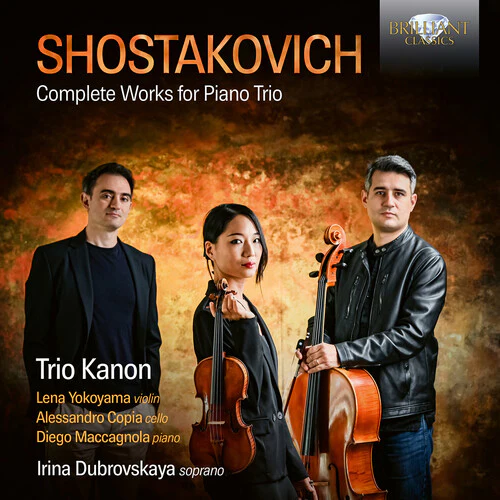
Dmitri Shostakovich (1906-1975) stands as one of the most compelling and complex composers of the twentieth century. Living and working in the Soviet Union, he was constantly caught between personal artistic expression and the demands of a highly restrictive political system. His music often reflects this tension, combining sharp irony, deep tragedy, and moments of bleak humor. Among his chamber works, the two piano trios hold a special place, offering an intimate window into his emotional world at two very different stages of his life. Shostakovich's Piano Trio No.1 in C minor, Op.8, was composed in 1923, when he was only sixteen years old. Despite his youth, the trio already shows remarkable maturity. Written in a single movement, it reveals a lyrical and introspective character, strongly influenced by late Romantic traditions. Long, singing melodies and rich harmonies dominate the work, especially in the piano part. More than twenty years later, in 1944, Shostakovich composed the Piano Trio No.2 in E minor, Op.67, one of his most powerful chamber works. Written during World War II and dedicated to the memory of his close friend Ivan Sollertinsky, the trio confronts themes of death, grief, and suffering. It's four movements range from haunting stillness to violent intensity. The final movement is particularly striking, incorporating Jewish musical elements that suggest both mourning and bitter irony, possibly alluding to the atrocities of the Holocaust. Also included are the 7 Romances on Poems by Alexander Blok, a vocal cycle for soprano, violin, cello, and piano in which each piece explores a different instrumental combination - from duos to the full ensemble. In these Romances, music becomes inward speech - whispered, often suspended over silence. Blok's poems, filled with dreamlike visions and disturbing symbols, become the very fabric of the composition: each word, each image, finds it's sonic counterpart in a language of subtle timbres, controlled dissonance, and unresolved tension. The result is a cycle of miniature music-theatre scenes in which the voice and instruments do not merely accompany, but engage in dialogue. Played with great intensity and commitment by the Trio Kanon and soprano Irina Dubrovskaya.
$14.99
Shostakovich: Complete Works for Piano Trio—
$14.99
Description
Dmitri Shostakovich (1906-1975) stands as one of the most compelling and complex composers of the twentieth century. Living and working in the Soviet Union, he was constantly caught between personal artistic expression and the demands of a highly restrictive political system. His music often reflects this tension, combining sharp irony, deep tragedy, and moments of bleak humor. Among his chamber works, the two piano trios hold a special place, offering an intimate window into his emotional world at two very different stages of his life. Shostakovich's Piano Trio No.1 in C minor, Op.8, was composed in 1923, when he was only sixteen years old. Despite his youth, the trio already shows remarkable maturity. Written in a single movement, it reveals a lyrical and introspective character, strongly influenced by late Romantic traditions. Long, singing melodies and rich harmonies dominate the work, especially in the piano part. More than twenty years later, in 1944, Shostakovich composed the Piano Trio No.2 in E minor, Op.67, one of his most powerful chamber works. Written during World War II and dedicated to the memory of his close friend Ivan Sollertinsky, the trio confronts themes of death, grief, and suffering. It's four movements range from haunting stillness to violent intensity. The final movement is particularly striking, incorporating Jewish musical elements that suggest both mourning and bitter irony, possibly alluding to the atrocities of the Holocaust. Also included are the 7 Romances on Poems by Alexander Blok, a vocal cycle for soprano, violin, cello, and piano in which each piece explores a different instrumental combination - from duos to the full ensemble. In these Romances, music becomes inward speech - whispered, often suspended over silence. Blok's poems, filled with dreamlike visions and disturbing symbols, become the very fabric of the composition: each word, each image, finds it's sonic counterpart in a language of subtle timbres, controlled dissonance, and unresolved tension. The result is a cycle of miniature music-theatre scenes in which the voice and instruments do not merely accompany, but engage in dialogue. Played with great intensity and commitment by the Trio Kanon and soprano Irina Dubrovskaya.